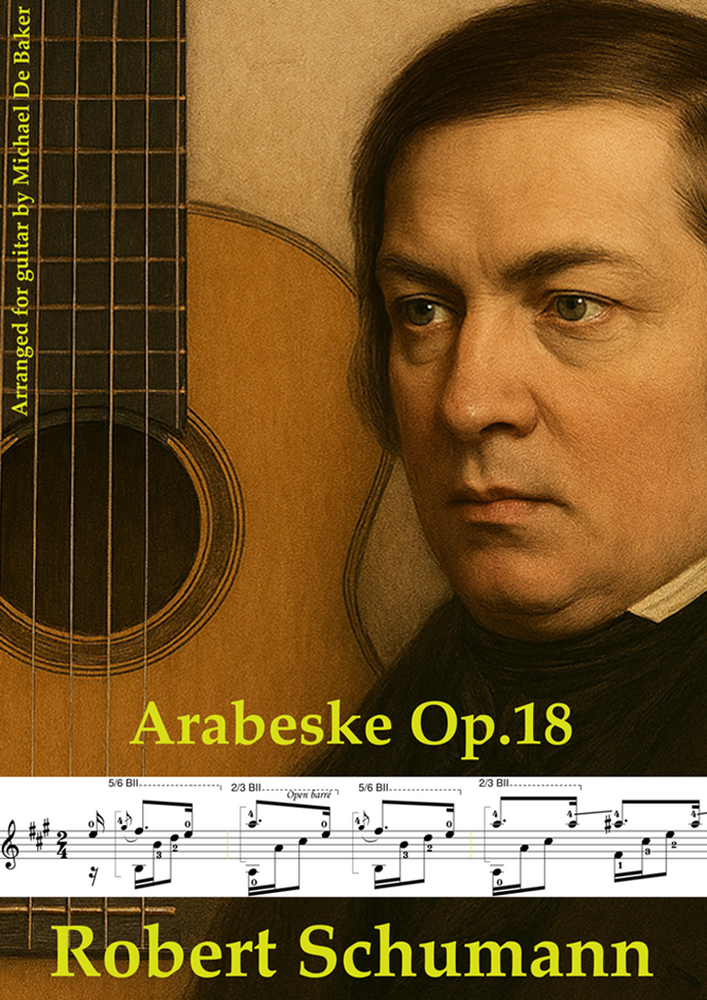
Robert Schumann Arabeske Op.18 arranged for classical guitar
Schumann’s Arabeske, Op. 18, and its Eusebius–Florestan duality find an unusually intimate home on the classical guitar. Its palette of touch, color, and micro‑inflection lets the music breathe with the vulnerability of Eusebius and the restless urgency of Florestan - capturing, like almost no other instrument, the struggle of a genius torn between undiluted lyricism and a world too coarse to receive it.
Schumann’s Arabeske, Op. 18, is more than a charming character piece: it is a distilled portrait of his divided inner life. Within its seemingly modest frame, the voices of Eusebius and Florestan continually surface - one inward, fragile, and lyrical; the other impulsive, restless, and unwilling to compromise. On the piano, these forces often appear as striking contrasts. On the classical guitar, they become something more intimate and exposed.
The guitar’s expressive power resides in touch and timbre. A slight change in nail angle, a warmer attack closer to the fretboard, or a barely audible delay between voices can transform a phrase from hesitant confession to radiant affirmation. This makes Eusebius’s world - his sighs, his half‑spoken phrases, his tender suspensions - feel almost whispered into the listener’s ear. The guitar can let a single note bloom, fade, or fracture in a way that mirrors the vulnerability at the heart of Schumann’s lyricism.
Florestan, by contrast, emerges through sharper articulation, brighter timbres near the bridge, and sudden surges of rhythmic energy. On the guitar, these gestures are less about sheer brilliance and more about raw impulse: the feeling of a thought that refuses to be smoothed over. The result is not a display of virtuoso bravado, but a direct line to Schumann’s own impatience with a world that often failed to understand his poetic ideals.
In this arrangement of the Arabeske for classical guitar, the instrument becomes a kind of confessional space for Schumann’s divided soul. Its capacity for color and nuance illuminates the tension between undiluted lyricism and the harsh reality of a world unresponsive to it. We hear not just a beautiful piece, but a mind wrestling with the impossibility of being fully heard.
This is Arabeske, Op. 18, not as salon ornament, but as inner testimony - and the guitar, with its uniquely human scale of sound and silence, lets that testimony speak with uncommon clarity.
Score: 11 pages
Preface, legend, content analysis and performance : 10 pages
Below is a link to Youtube which will allow you to get an idea of what this piece sounds like on piano. (Performed by Maurizio Pollini)
https://www.youtube.com/watch?v=KyJrxS82C4g&list=RDKyJrxS82C4g&start_radio=1
Over the coming months, I will be playing short excerpts from all pieces listed in this catalogue on classical guitar myself and post them on my Youtube channel, titled:
Michael De Baker Arrangements for Classical Guitar.
Thanks for tuning in. Wishing you much musical enjoyment and many rewarding hours with our instrument, the classical guitar.
Michael