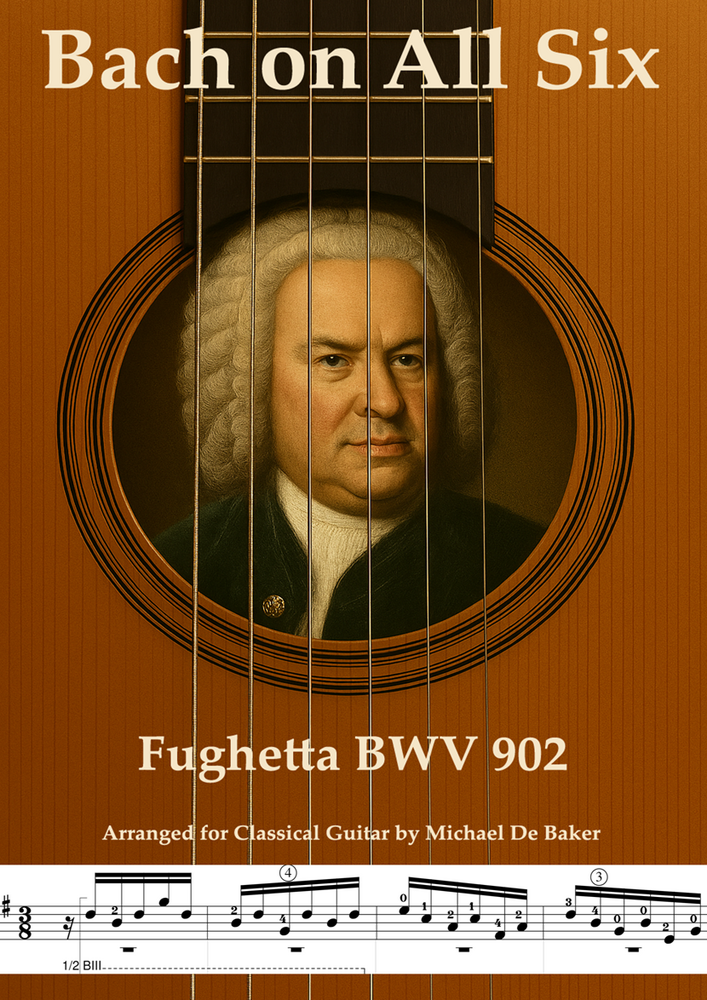
Bach J.S. - Fughetta BWV 902
Bach’s Fughetta in D major (BWV 902) - here given in G major - becomes a crisp, bright miniature on the guitar, where its quick exchanges and nimble subject entries feel almost tailor‑made for the instrument. This arrangement lets the counterpoint speak with effortless clarity, turning the piece into a compact burst of sparkle and character.
In Bach’s usage, a fugue is a fully developed contrapuntal composition with extended architecture and multiple voices, while a fughetta is a miniature fugue - shorter, lighter, and more transparent, often designed as a concise study in fugal technique.
Bach’s Fughetta in D major (BWV 902) – here rendered in the key of G major - is a small piece with a surprisingly expansive imagination. Its subject is built from the simplest possible material: a broken‑chord outline that traces a I–V–I progression, stretched and animated across seven bars.
This unassuming idea becomes the seed for the entire work, generating a chain of imitative entries that feel both playful and tightly organized. The charm of the fughetta lies in how Bach turns this modest harmonic skeleton into a lively contrapuntal conversation.
In this guitar arrangement, the subject’s arpeggiated shape feels instantly at home. The guitar’s natural affinity for broken‑chord textures allows the line to unfold with ease, while the surrounding voices maintain their independence without sounding forced.
The imitative exchanges gain a new warmth from the instrument’s resonance, and the harmonic sidesteps acquire a more vocal quality as they pass through different registers.
What emerges is a piece that feels tailor‑made for the guitar: concise yet expressive, transparent yet full of motion. It works beautifully as a recital opener or as a bright interlude between larger works, offering performers a chance to explore Bach’s contrapuntal wit in a format that is both approachable and musically satisfying.
In this arrangement, the fughetta reveals its full personality - a miniature built from the simplest materials, transformed by Bach’s craft into something unexpectedly radiant.
Score: 3 pages (Double-stave notation)
Preface, legend & performance notes: 7 pages
Double-stave notation
Bach fugues and fughettas are presented in double‑stave notation to preserve the clarity of Bach’s contrapuntal writing.
A single guitar stave compresses multiple voices into one visual plane, forcing the performer to infer voice‑leading, sustain, and articulation from stem direction alone.
By contrast, a two‑stave layout restores the spatial logic of the original keyboard sources: upper voices remain visually distinct from the bass line, imitative entries are immediately recognizable, and the structural relationships between subject, answer, and countersubject become far easier to follow.
For the guitarist, this clarity is not merely cosmetic: it directly supports informed fingering, balanced voicing, and a more faithful realization of Bach’s polyphonic texture.
Double‑stave notation therefore serves both musical integrity and practical performance, offering a score that reflects the true architecture of the fugue rather than a compressed approximation of it.
Below is a link to Youtube which will allow you to get an idea of what this piece sounds like on keyboard. (Performed by Robert Hill on the lute-harpsichord)
https://www.youtube.com/watch?v=66n1YY40Cbs&list=RD66n1YY40Cbs&start_radio=1
Over the coming months, I will be playing short excerpts from all pieces listed in this catalogue on classical guitar myself and post them on my Youtube channel, titled:
Michael De Baker Arrangements for Classical Guitar.
Thanks for tuning in. Wishing you much musical enjoyment and many rewarding hours with our instrument, the classical guitar.
Michael
Contact. If you’d like to reach out - whether about repertoire, arrangements, or upcoming projects - feel free to email me at mdebakerclassicalguitar@use.startmail.com