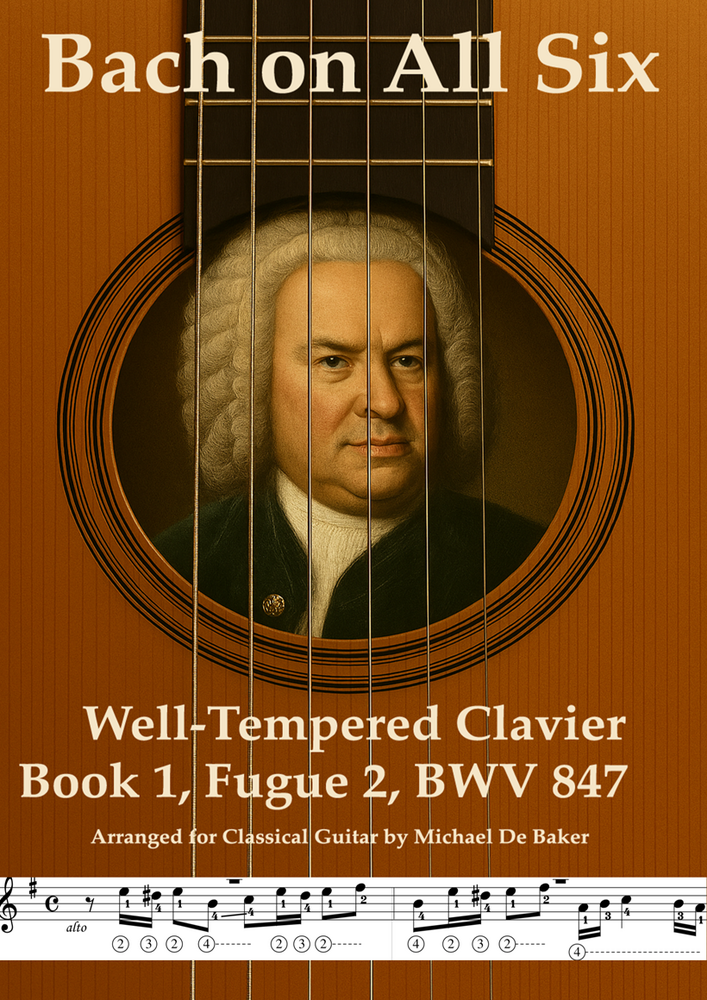
Bach J.S. - Fugue BWV 847
The Fugue in C minor (BWV 847) - here given in E minor - is one of Bach’s most concentrated demonstrations of three‑voice counterpoint, and this arrangement preserves that texture in full. The subject - with its quick, mordent‑like opening gesture - remains sharply profiled, while the countersubject and accompanying line retain their independence and rhythmic identity. The guitar’s ability to project distinct voices makes the fugue’s tight motivic exchanges surprisingly transparent, offering guitarists a true three‑part experience distilled into six strings.
Bach’s Fugue in C minor (BWV 847) - here rendered in E minor - is one of the most concentrated demonstrations of three‑part counterpoint in the Well‑Tempered Clavier, and its clarity makes it unusually well suited to the classical guitar.
The subject itself is a model of compressed energy: a quick, mordent‑like dip to the lower neighbor followed by a rising line that propels the music forward with unmistakable urgency. This gesture becomes the engine of the entire fugue, reappearing in every voice and constantly reshaping the musical landscape.
In this arrangement, the three‑voice texture is preserved in its entirety. Each line - the incisive subject, the nimble countersubject, and the accompanying voice that threads between them - retains its independence and rhythmic identity.
The guitar’s ability to articulate contrasting timbres across strings allows the voices to remain distinct even in the densest passages, giving performers a genuine trio experience on a single instrument. The result is a fugue that feels transparent rather than compressed, with each entry clearly audible and each stretto passage gaining a new sense of immediacy.
The guitar’s resonance adds a different kind of depth to the piece: the subject’s opening gesture gains a sharper profile, the countersubject’s running motion acquires warmth, and the harmonic turns take on a more vocal quality. What emerges is a version that honors Bach’s contrapuntal rigor while revealing colors and articulations unique to the guitar.
Although Bach never intended the D‑minor Prelude (BWV 851) to precede this fugue, the two pieces form a remarkably natural partnership on the guitar. The prelude’s steady harmonic motion sets the stage for the fugue’s concentrated contrapuntal drive, creating a satisfying musical arc that feels organic on the instrument. Purists may raise an eyebrow, but the combination opens a new and substantial corner of the Bach repertoire for guitarists - one that feels both respectful and creatively invigorating.
Score: 4 pages (Double-stave notation)
Preface, legend, and performance notes: 20 pages (Includes an anlysis of the fugue´s elements: subject, countersubjects, episodes, etc.)
Below is a link to Youtube which will allow you to get an idea of what this piece sounds like on piano. (Performed by Marco Grilli)
https://www.youtube.com/watch?v=hyLwEXhC31A&list=RDhyLwEXhC31A&start_radio=1
Over the coming months, I will be playing short excerpts from all pieces listed in this catalogue on classical guitar myself and post them on my Youtube channel, titled:
Michael De Baker Arrangements for Classical Guitar.
Double-stave notation
Bach fugues are presented in double‑stave notation to preserve the clarity of Bach’s contrapuntal writing.
A single guitar stave compresses multiple voices into one visual plane, forcing the performer to infer voice‑leading, sustain, and articulation from stem direction alone.
By contrast, a two‑stave layout restores the spatial logic of the original keyboard sources: upper voices remain visually distinct from the bass line, imitative entries are immediately recognizable, and the structural relationships between subject, answer, and countersubject become far easier to follow.
For the guitarist, this clarity is not merely cosmetic: it directly supports informed fingering, balanced voicing, and a more faithful realization of Bach’s polyphonic texture.
Double‑stave notation therefore serves both musical integrity and practical performance, offering a score that reflects the true architecture of the fugue rather than a compressed approximation of it.
Thinking Vertically in Bach’s BWV 847 Fugue
Approaching Bach’s three‑part fugue BWV 847 on the guitar demands a shift from horizontal thinking to a fully vertical mindset. Instead of following a single melodic line from left to right, the guitarist must assemble each measure as a small architectural unit - three independent voices stacked in real time.
In C time, with 31 measures and four beats per measure, the piece becomes a set of 124 miniature puzzles, each one asking:
How do these voices fit together, and how do I make them speak as one coherent texture on the guitar?
This process may seem painstaking at first. Each beat must be pieced together, fingerings tested, consistentcy in articulation checked, sustain negotiated, and the balance between voices carefully weighed. But once these vertical structures are mapped internally, the fugue begins to reveal its true character. The counterpoint becomes not a tangle to decipher but a living, breathable texture under the hands. The guitarist gains the freedom to shape phrases, highlight entries, and let the architecture unfold with clarity and confidence.
And the reward is extraordinary. This is the fugue many guitarists have dreamed of playing but quietly assumed would remain out of reach. Built beat by beat, however, it becomes not only playable but deeply satisfying: an encounter with Bach’s craft that feels both intimate and monumental.
The work invested in those 124 puzzles transforms into a performance that is as rewarding to play as it is to listen to.
Thanks for tuning in. Wishing you much musical enjoyment and many rewarding hours with our instrument, the classical guitar.
Michael
Contact. If you’d like to reach out - whether about repertoire, arrangements, or upcoming projects - feel free to email me at mdebakerclassicalguitar@use.startmail.com