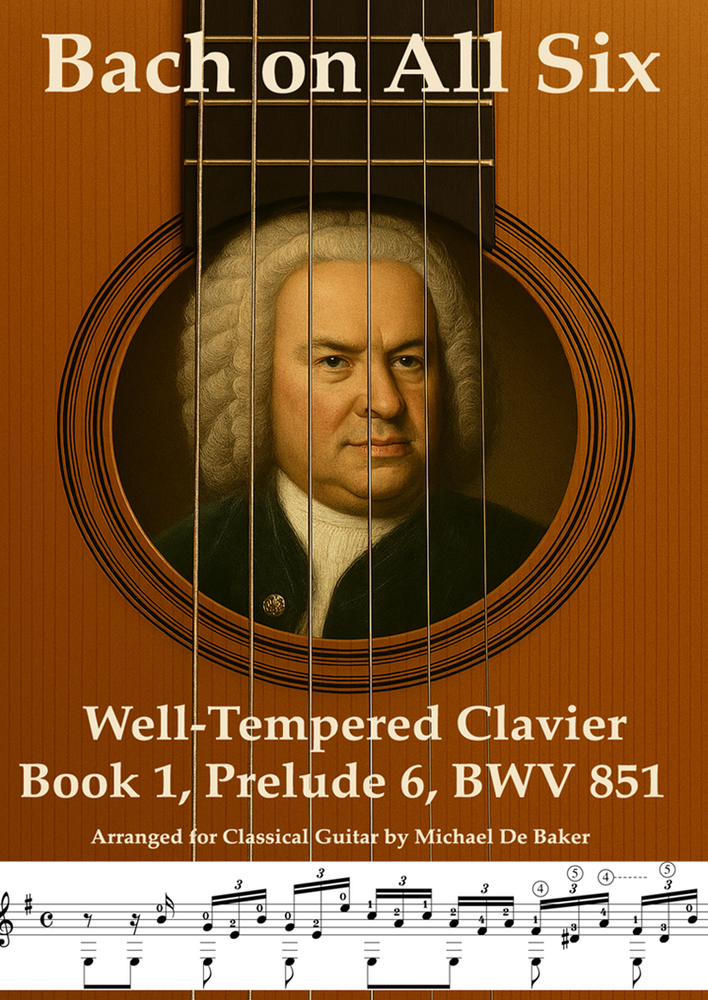
Bach J.S. - Prelude BWV 851
Bach’s Prelude in D minor from the Well-Tempered Clavier (BWV 851) – here given in E minor - unfolds almost entirely from a single idea: a steady stream of broken chords that shift through a series of luminous harmonic changes. This arrangement brings that structure directly into the guitar’s natural vocabulary, letting players explore Bach’s design through textures that feel instantly familiar yet musically revealing.
Bach´s Prelude in D minor (BWV 851) from the Well‑Tempered Clavier, Book I – here rendered in the key of E minor - is built on a deceptively simple engine: continuous broken‑chord patterns that travel through an elegant sequence of harmonic shifts.
For guitarists, this language feels uncannily native - the right hand’s arpeggiated motion, the left hand’s constant rebalancing of chord shapes, and the sense of harmonic “breathing” all align with the instrument’s most instinctive gestures.
This arrangement preserves the prelude’s architectural clarity while shaping the figuration so it lies comfortably under the fingers. The broken‑chord texture remains the driving force, but the guitar’s resonance adds a warmth and immediacy that highlights each modulation with new color.
Players can trace Bach’s harmonic journey with unusual transparency, experiencing how a single structural idea transforms as it moves through shifting tonal landscapes.
The result is a piece that feels both faithful and freshly idiomatic - a study in touch and balance, a rewarding exploration of Bach’s harmonic imagination, and a natural fit for guitarists who enjoy music that grows organically from familiar technical patterns.
Although Bach never intended the D‑minor Prelude (BWV 851) to sit beside the C‑minor Fugue (BWV 847), the two pieces form a remarkably natural partnership on the guitar. (Both have been arranged for guitar in E minor).
Purists may raise an eyebrow at the re‑contextualization, but the pairing reveals a compelling musical arc: the prelude’s steady broken‑chord current flows seamlessly into the fugue’s taut contrapuntal drive. Together they create a substantial, stylistically coherent diptych that feels entirely at home on the instrument and meaningfully broadens the Bach repertoire available to guitarists.
Score: 5 pages (Single-stave notation)
Preface, legend, and performance notes: 7 pages
Below is a link to Youtube which will allow you to get an idea of what this piece sounds like on piano. (Performed by Hrvoje Stanekovic)
https://www.youtube.com/watch?v=S4ycJS7U5do&list=RDS4ycJS7U5do&start_radio=1
Over the coming months, I will be playing short excerpts from all pieces listed in this catalogue on classical guitar myself and post them on my Youtube channel, titled:
Michael De Baker Arrangements for Classical Guitar.
Thanks for tuning in. Wishing you much musical enjoyment and many rewarding hours with our instrument, the classical guitar.
Michael
Contact. If you’d like to reach out - whether about repertoire, arrangements, or upcoming projects - feel free to email me at mdebakerclassicalguitar@use.startmail.com